Peering Dark History of Cambodia

Thursday, December 29, 2011

In the mid-1970s, Cambodia's Khmer Rouge regime controlled by the leadership of Pol Pot, who has ideals transform Cambodia into an agrarian state with ultra-Maoist adopts. He was moving people from city to village to work in the fields and kill anyone who opposes. Many innocent people, including women, children, and parents who are victims of atrocities the Khmer Rouge regime.

Ek Cheoung


Some tourists walked through mass grave Cheoung Ek on the outskirts of Phnom Penh, Cambodia. Photo Credit: AP / Heng Sinith


Located about 14 km from Phnom Penh, the capital of Cambodia, Cheoung Ek is one of the Khmer Rouge regime killed and buried the people who are considered against the power of the regime. The prisoners who were imprisoned in Tuol Sleng (read article Part 1), will be brought to Cheoung Ek to be killed.

I went to Oak Cheoung using tuk-tuk for an hour, with a fee of $ 7.The road to the outside of the city is very dusty, so I had covering her face with a scarf. At first glance, this place looks like a garden with shady trees. Many butterflies are also flying. The souvenir merchants offering their wares.


Admission to the Cheoung Ek is $ 2 (although the official currency of Cambodia is the Riel, they also accept payments in U.S. dollars).

In Cheoung Ek, the most prominent building is a high tower, in which there are approximately eight thousand piles of human skulls regime of Pol Pot's atrocities. Piles of used clothing of the victims are also displayed in the tower. The tourists, including me, was busy taking pictures. The scenery was incredible and tragic.No one is laughing and joking when taking pictures.

Completed around the tower, I decided to surround the complex Cheoung Ek. In a corner, I saw a variety of killer tool that was used to kill the prisoners. Bayonet, iron chains, and various other killer equipment.

In the other corner I found a large hole to the instructions in local languages ​​and English that roughly reads "Here was found a pile of victims without heads". While in other places there are signs "Here is found the victim in a state of naked women". There are many other signs as chilling.

Fortunately, in contrast to Tuol Sleng, Cheoung Oak is an open field so it does not seem so terrible. The tower which rises with a pile of skulls still dominate this place.

Although the stomach is wrapped around, and there are several food stalls outside the complex, I do not have appetite to eat. I decided to return to the city center and spend time in the city.

Alternative attractions in Phnom Penh

Cambodia is an attractive country, with a remarkable history.Tragic, cruel, yet memorable. However, if you're not a history buff, especially those related to war and torture, there are many sights to see in Phnom Penh.


Palace of King Norodom with Silver Pagoda in it is one you must visit. This place is very beautiful with neat gardens. Another alternative is the National Museum, which is also the place where historic objects, but from the more remote than with the history of the Khmer Rouge.

The Royal Palace in Cambodia, one of the interesting attractions to visit. Photo Credit: AP / Heng Sinith

Wat Phnom, a pagoda in the middle of the city are also worth visiting. You can go up and take pictures with the existing reliefs and statues. In this place a lot of monkeys, so be careful with your belongings.

If you love to shop, you have to go to the Russian Market or Russian Market. This place sells a wide range of souvenirs, ranging from silks, jerseys, clothing, and knick-knacks. Prices in the Russian market is relatively inexpensive and most importantly, easily negotiable!

Source : www.yahoo.com

Indonesian Culture : Name Origin According to Experts Minangkabau

Tuesday, December 27, 2011

Opinions about the origin of the name of Minangkabau is very diverse. Some are derived from folklore, which is a growing opinion by word of mouth. There is also the origin of the name contained in the Tambo Minangkabau Minangkabau Nature.
Because of the growing, research is also conducted by experts. Good historians, experts Sociology, Anthropology, and others. So that from this study also revealed a number of words that became the origin of the name of Minangkabau in the opinion of these experts. Until now has not been established by clear where the origin of the actual name of the Minangkabau.

However, with increasing human intelligence, then the opinion that more people believe is the origin of the name Minangkabau according to these experts. Because this opinion has gone through the process of research which is also corroborated evidence by passing the process of scientific studies that are based on approaches that could be accounted for in accordance with scientific references.
Here are some of the origin of the name of Minangkabau in the opinion of the experts are:

WORD FROM Minanga TAMWAN

Prof.Dr.Poerbacaraka Minangkabau say that the name derives from the language that is Minanga Tamwan Sangsekerta. These words are contained in the inscription Kedukan Mount.

Kedukan Bukit Inscription is an inscription which tells the story of Tamwan Minanga territorial expansion. Namely the expansion of the region that started from the victory of King Minanga Tamwan envoy led Datuk Cribijaya (Dt.Sibijayo, Commander of War Minanga Tamwan) against the Pirates are a lot of disturbing people around Palembang River (River Musi) now.

In this inscription is mentioned, among others,
"The Pertuan Hyang off twenty laksa
soldiers from Minanga Tamwan led
Cribijaya (Dt.Sibijayo) through a sacred journey,
with the aim of expanding the state until
bring prosperity. "

All this is set forth in his book History of Indonesia Prof.Dr.Poerbacaraka I. It's just where is the area Minanga Tamwan it, is still being debated. According keterengan Prof.Dr.Poerbacaraka called Minanga Tamwan it is a region that lies between the two Great River meet.

Some experts suspect that there are two major rivers that are the Kampar Left and Right Kampar. But if the question is the Kampar River Left and Right Kampar, then most likely the area around Barelang.
According to the author's own research and study with Community

Sejarahawan Indonesia (MSI) LUHAK Limopuluah (Yulfian Azrial, et al, 2003), Minanga Tamwan may not intended as a meeting between two great rivers physically. Because the physical confluence of more commonly known as the estuary rather than Minanga Tamwan.

But Minanga Tamwan could actually show a region or area that became the meeting place of two great rivers. This is because the main highways of our society in ancient times the river.

So if we see from the map, two major rivers in central Sumatra island region is only one, the area contained between the Hulu Sungai Kampar with Batang Sinamar (Kuantan / Indragiri). This area is located between maek and Mungka. Precisely that is the Mount of the Moon Stone in Nagari Gutters Mauá.

This area is also located just a short distance from the Equator line. Then when viewed from the origin of language he said according to Tamil, the word is derived from the word Gutters Ta which means big and Lang are airports. So Gutters mean big airports.

The existence of Bukit Batu This month can be described as follows: One side down to Kampar in maek rods, while the other side of the trunk down to the kehilirnya Sinamar was known also as the Trunk Kuantan or Indragiri River.

On top of this hill there are several sites that are major trading centers such as the former aspect Pokan Akad, Ranah Pokan Tuesday, Ranah Pokan Komih, Ronah Pokan Friday, Saturday Pokan aspect, etc..

This place certainly never bring merchants who rose from two major rivers, namely that rises through the stem and Kampar and the rise of the Batang Kuantan (Indragiri). But to ensure this is still needed further research.

WORD FROM Pinang KHABU

Prof.Van der Tuuk, a professor of Dutch nationality saying that the Minangkabau is Khabu Pinang. That land base, land of origin or ancestral lands .. This opinion is also corroborated by the statement of Thomas Stanford Raffles, a British national who had served in the British Governor-General of Indonesia in 1811 until 1818.

This statement contained in his statement after making explorations into various corners of the village and the forests in the region of Central Sumatra. In a note Raffles states that: ".... Here we find traces of a great empire (Minangkabau) whose names are scarcely known to us at all, but a very real place of origin is the Malay nations are scattered in the archipelago. "

To facilitate this we remember the journey Raffles, name Raflesia flower is one of a memento to capture the natural exploration of Raffles are conducted. Raflesia point which is the name for a kind of giant flowers that are found by Raffles. In the aspect Minang we used to call it by Bunge carcass.

The statement that the Minangkabau is a land of origin is also supported by many facts and data. Moreover, all ethnic Malays historically originated from Minangkabau. Like the Malay Riau, Jambi, Deli, Aceh, Palembang, Malay Peninsula, Borneo, and Bugis. Even the Kubu tribe, Sakai, Talang Mamak, Tribe Kids Sea in the Strait of Malacca, etc., purporting to be from Minangkabau.

Other evidence of this recognition such as a carved inscription on the tomb of Sultan Series Tajuddin in Brunei, among others, reads as follows:

"The series ordered to Mr. Tajuddin Sultan Haji Abdul Latif Khatib explained that this lineage is known to posterity, the king who had a royal throne in the State Brunai Darussalam hereditary to heritage nobat ¬ take the address of the state and country clapper Johor Kamalul Maqam , who took the heirloom nobat countries and address of the Minangkabau villages Andalas ... etc. ".

Parasasti illustrates that the Malays in Peninsular Malaysia is now also originated from the Minangkabau. For example, as in Johor, Selangor, Malacca, Pahang, etc.. Even to the most recent generation, namely the then inhabited Affairs IX. Historically, most of them are crossing the Straits of Malacca after passing through the flow Trunk and Trunk Rokan Kampar.

WORD FROM Menon Cobos

According Prof.Dr.Muhamad Nainar Hussein, a professor at the University of Madras. He said the word originated from the Minangkabau Menon said Cobos.

Menon Cobos means the land of noble or pure land. Regarded as a pure land or land glorious in this area is also considered a place of origin of the ancestors of the Malays.

WORD FROM Binanga KANVAR

According to Muhammad Zain said Prof.Sutan Minangkabau derived from Binanga Kanvar. Binanga Kanvar means the Kampar River estuary. According to the Kampar River Estuary is the beginning of the kingdom of Minangkabau.

Another opinion that was attuned to the Prof.Sutan Mohammed Zain is a statement by a Chinese national named Kua Chan Yu. This statement in a note he wrote in his journey.

In the note he explained that when he once came to Kampar estuary in the 13th century. He explained that in Kampar estuary that he found a most crowded commercial airports in the central island of Sumatra. These notes are reminiscent of a similar record of its predecessor, I-Tsing, a few centuries earlier.


WORD FROM MINA KAMBWA

While doing research for the deepening of the material in some books, I (Yulfian Azrial, 2011) view that the word Minangkabau also be derived from the Sanskrit term, which is said Mina Kambwa. Mina Kabwa means the country or countries Dragon Pillar Sky Pillar is comprised of a row of Volcano.
In terms of etymology, the word mina in Sanskrit language means Dragon. In ancient Hindu stories, the term Mina or Naga is often portrayed as a symbol of the cluster of volcanoes located in Bukit Barisan mountains today. While Kambwa or Skambwa means pillar or some sort of pedestal sky. So Mina Kambwa meaning sky pole or a pillar consisting of a cluster of volcanoes.

Mina Kambwa term is often called the mandala-Hindu mandala. In the Hindu mandala mandala-like in the Shri Yantra and the Kalachakra Mandala, a row of Mount Merapi in the cluster of mountains mountain chain is often referred to as Mount Meru or Mount of the Holy heaven. The biggest and highest mountain called Mount Mahameru often symbolized by the great pyramid. The mountain is believed by most experts is Mount Krakatoa erupted in the year 11,600 BC.

At that time the volcano erupted with a blast supervuklanis her, which makes the mountain collapsed like a leaky balloon. High mountain peaks which originally was submerged beneath the sea, turn into a giant caldera. Smoke and dust covered almost the entire sky even the world. The thing that makes the experts Geological and Nuclear Physicists argue that this is what causes the end of the Ice Age Pleistosen.16

Before the eruption of Mount Krakatoa in the region illustrated that there are peaks of world civilization that later spread to parts of the world lain.17 To commemorate this civilization in the land of their ancestors, then its spread has been found in various places many symbols of the triangle. Symbolic representation of Mount Meru or Mount of the Holy heaven.

Even in a place built a duplicate of Mount Meru is commonly called a pyramid. For example as found in Egypt, Mesopotamia, Greece, in Mayan, and Aztec tribes in the Americas. Even with putting the bodies in this building, as imagined by those putting the deceased in the belly of Mount Heaven.

(Quoted from the Book of Nature Minangkabau culture, Yulfian Azrial, Volume 4)

Peering Dark History of Cambodia

Tourism in Cambodia is not only limited to Angkor Wat, a magnificent Buddhist temple, but also a tourist attraction with a dark history that lies to the east of the country.

Cruelty group leader Pol Pot's Khmer Rouge in the 1970s left a deep wound for Cambodians today. But the legacy became a tourist attraction, especially for those who like history.

A tourist goes to see the photos of detainees who had entered the S-21 prison in Phnom Penh, Cambodia. Photo Credit: AP / Heng Sinith

I started my journey with a visit to this museum, which is approximately a one hour drive from Phnom Penh International Airport. I arrived at their destination about three o'clock, so it still has about two hours to explore the place.

At first I thought Tuol Seng is just an ordinary museum, which is also found in many other countries, but apparently not. This place presents something very different.

Tuol Sleng was once a high school in 1975 converted into a prison called Security-21 or S-21. Reportedly there were about 17 to 20 thousands of innocent Cambodians and some foreigners who had been imprisoned here. And of all people arrested, only seven people who survived until the Khmer Rouge regime was overthrown.

Entering the complex Tuol Sleng, still not seeing anything different until I approached one of the buildings. On the walls seen a sign that prohibits visitors laughing and joking. I went inside. It's hard to express what I feel inside the building. The school has been converted into a torture camp.

Classrooms filled by various means of torture, iron chains, while from the window I could see the high fence of iron wire. Other spaces that have been transformed into cells measuring 1x1 meters. Blood spots are still visible everywhere.

For me, and I'm sure for other visitors, a sign of forbidden laughter is of no use. See what is inside, it's impossible for us to laugh and joke. The place was like happiness absorb anyone who visited. If I may borrow JK Rowling's imagination, was at Tuol Sleng like to be near the dementors!

In another room we saw a variety of facial images. The officers photographed every S-21 prisoners who go to prison. All with a blank expression. Look as if they imply that they know life will not be long anymore. And before death must have been tortured beyond the limits of humanity.

I rent a tour guide who explains the country's dark history. He tells his own experience, how his father and older brother was captured by the Khmer Rouge and never returned. He also tells about the crying babies being thrown away by the guards S-21 to the barbed wire.

One of the most prominent in this place is a Map of the Skull, which is a map of Cambodia made of 300 human skulls. Elsewhere castoffs prisoners stacked into one. Photographs and paintings depicting the torture of innocent people on the wall. Somehow, even after decades of metallic smell of blood still smelled.

The sun began to sink, any visitor to stay a bit. I completed the tour as soon as possible to get down to the page. At the very least, open-air atmosphere less dire than in the living-room that smelled blood. Outside, there are still many torture device used by the guards S-21. One is a large barrel-lined barrel.

In the past, students use the vat of water to wash the face. However, when the place was converted into a prison, officials built on top of the pole-barrel keg is. Prisoners will be hung upside down, with head immersed in water.

My tour ended that day. My journey peek dark history of Cambodia will continue in the 'killing fields' Choeung Ek, in the next article.

source : www.yahoo.com

Indonesian Culture : Minangkabau

Monday, December 19, 2011


'Urang Minang'
, a term commonly used to indicate the identity of Minangkabau society and inhabit most of the province of West Sumatra. Area was originally a three indigenous territorial unity called Tigo LUHAK nan (region three), namely: LUHAK Agam, LUHAK Fifty Koto, and LUHAK Tanah Datar.

The origins of the name of Minangkabau is very diverse, but according to legend, the name originated from the Minangkabau event victory in the shoot buffalo with people who want to seize the kingdom of Majapahit this region (Gusdiasdial), as it sounded in the tambo talibun Minangkabau origin of the name below :

· Karano tanduak stale paruik tajalo
· Dead at Koto Padang Sphere
. Tuo jo Mudo sungguahpun wonder
· Arrival of indak karano advised
· Deck karano Cadiak Niniak Kito
· Because manyambuang in galanggang ground
· Dipadapek luck kamujuran
· Namo Minangkabau Timbualah

Minangkabau society is one of the people who still cling to their customs. Matrilineal kinship system is one differentiator with other tribes located in Indonesia.

Customary Functions
Minangkabau society is a society that still cling to their customs. It can take a look at how traditional philosophy still they run in their daily lives.

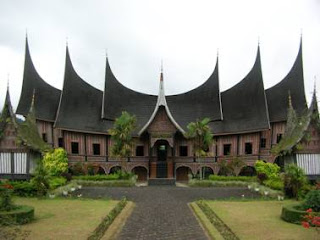
A home gadang, a main house owned by a group of Minangkabau society is bound by a particular tribe. As the main house, the house is a place to establish a large sieve events customs and other important events of the tribe concerned.

Customary activities on Minangkabau society we have described based on their life cycle, namely:

· Rain Shower
· Circumcision
· Marriage
· Batagak Gala (Appointment Datuak)
· Death

Customary function in a large sieve home we could call the function that took place in a temporary home gadang, because the event does not take place every day and takes place at certain times only.

Everyday Function
The house is a container that holds gadang daily activities of its inhabitants. Gadang house is a house inhabited by a large family with all their activities every day. Definition of a large family here is a family consisting of father, mother and daughter, both who have been married or who have not married, whereas boys did not have a place in the house gadang.

This function is actually a more dominant place in a large sieve home. As usual residence for society generally, this is where the interaction takes place between family members. Everyday activities such as eating, sleeping, hanging out with family members and others more dominant place here, in addition to traditional activities as described above.

Along with the passage of time and the increasing activity of the community especially those still using gadang home as residential facilities, has led to the increase of new functions in the home gadang. Architecturally, we know that each activity requires the spaces to accommodate these activities. So also at home gadang, new spaces that appear on the home gadang (transformation space) is a response to the increasing activity as well as the diversity of needs of residents of the large sieve.

we know that each activity requires the spaces to accommodate these activities. So also at home gadang, new spaces that appear on the home gadang (transformation space) is a response to the increasing activity as well as the diversity of needs of residents of the large sieve.

Tower House as a Cultural Artifact
As already described above, the Minangkabau society is a society that embraces matrilineal kinship system, which according to maternal lineage. As a society that embraces matrilineal system, the tribal system was also according to the mother, so if the mother has an interest Piliang then hereditary, the children in these families also have the same tribe with his mother.

Gadang home as a place to live with for the people who live Minangkabau matrilineal system of kinship (according to matrilineal descent) women have a privileged position and place in the home gadang. Any married woman who will get a room, while the youngest female terujung got a room which will then be moved if it has a future husband. The boy has no place on this gadang house, since the former boy-man who started growing up will stay in the mosque-surau family or go wander out of the village.

Houses gadang Minangkabau society in addition to functioning as a residence also serves as a symbol of the existence of a people. Another function of this gadang house is as a place to consult and agree on a place to perform traditional ceremonies, like a rung on the establishment of a house gadang speech, namely:

· Home gadang base HB
· Pole banamo Carbonara nature
· Pintunyo banamo Dalia kiasannyo
· Banduanyo Sambah manyambah
· Bajanjang naiak batanggo down
· Dindiangnyo panutik shame
· Biliaknyo square bunian

The purpose of the speech above is the number of poles contained in a large sieve home is one of the factors that determine the size of the building to be erected, the location of the door determines the alignment system adopted, the pendulum (high-low game gadang floor of a house) which is the boundary between outside and inside the home that can not be passed without any particular order, a walled house mengkiaskan cultural values ​​and civilization while the room is a place to store valuable items.

Broadly speaking, living in a house we can gadang categorizing into

Four main zoning. Penzoningan is based on the hierarchy of spaces contained in gadang house itself, namely:

1.Publik, namely the living room or common space which is a room off without any barrier.
Private 2.Semi, the transitional space contained bandua front bedroom and anjuang (special room) located at the ends of the house gadang which can be found in some types of home gadang.
3.Privat, the bedrooms are there in the house which was formerly based on the large sieve to the number of girls who are owned by sipemilik home.
4.Servis, the kitchen is at once a traditional kitchen are still using wood as fuel.
Some characteristics of the architecture of the house is a large sieve:

1.Tingkat / or the degree of cultural specificity.
Gadang house is a building typical of the region of West Sumatra, as written in the book Minangkabau Tower House of Traditional Architecture, the architecture of the building houses a relic gadang not written to us, which is a hallmark of the past greatness of Minangkabau culture. No matter how the change occurred, but sieve house building architecture which we witness now is the effect of building styles of the past.

model, plan, morphology and building specifications, the relationship between elements and the complexity of the building based on where a building is located.
Broadly speaking gadang home model is divided into two major groups are divided according to two kelarasan or customary law in Minangkabau society.

Both kelarasan system are:
• System kelarasan Koto Piliang
The hallmark of the model homes that use the system kelarasan gadang Piliang Koto is a anjuang found on the left and the building. The pavilion is a place of honor in a large sieve home is elevated a few feet from the surface of the floor of the building.
• System Bodi kelarasan Caniago.
While at home who use the system kelarasan gadang Bodi anjuang Caniago not know the term. So the floor of the house bangian gadang from tip to base have the same height floor.

Building elements in the house gadang it can also be divided into two main parts, namely:

a.Halaman Gadang a home page is an open house is important for an gadang house, usually a home page on the large sieve is a place to hold events on a kinship.

The elements contained in a large sieve home page is:

Rangkiang Rangkiang is a building that contained yard of a house gadang the square and roofed bergonjong fibers that serve as rice storage barn erected in front of the house gadang.
According A.A. Navis (1984) there are several types gadang rangkiang on a house, such as:

a.Sitinjau lauik
This is the kind Rangkiang rangkiang rice storage place that will be sold to buy household needs that can not be made or done alone.
b.Sibayau-bayau
Rangkiang of this type serves as a repository of rice that will be used for everyday purposes.
c.Sitangguang coconut
Is a type rangkiang used as a rice storage place that will be used as a backup during a famine comes.
d.Rangkiang kaciak
Rangkiang used as a rice storage place that will be used as seed and planting paddy processing fee during the next planting.

Tabuah ban Is a rectangular building, thatched roofed and bergonjong to place a drum made of wood length. Usually used as a tool to provide at the time of danger signs or notices at the time there is an event.

Lasuang and pestle Is a home gadang fittings commonly used as a tool to pound rice.

Kitchen Service area on the home gadang which usually also part of the house, but in most home kitchens gadang gadang usually separate from the house.

b.Elemen building Building elements contained in a large sieve home is:
• Password
Foundation is contained in a large sieve house from natural stones.
• Ladder
Stairs on a house made of materials gadang wood materials and is usually preceded by a natural flat stone, usually the number of steps is odd number, like 5, 7 and 9.
• The pole
There are various names and types of columns on a house, giving the name on each pole at a house gadang is adapted to function at home and it's large sieve.
• Beams
Is the binder between the pole with a pole on a house that ran large sieve at the top or the bottom of the pole.
• Space
Space or space on a large sieve house is a room that is formed by rows of columns that ran in the house the large sieve.
• room
Booth is a private area for the occupants of a house large sieve, sieve chamber at the base of the house inhabited by parents and children while unmarried girls booth located at the end of the house inhabited by a large sieve bridal couple.
• Walls
The walls of the house gadang divided into three parts, the front wall, the wall Sasak, as well as the side walls. In general, the wall at home gadang is made of woven bamboo is bound by the boards as tulangannya.
• Roof
The roof of a house gadang usually consists of fibers, although in the present use of these fibers has been replaced by widespread use of zinc material.
• gonjong
Gonjong are characteristic of traditional residential Minangkabau society, so that residential Minangkabau society is also known as the home bagonjong.

+-The use of certain materials, colors, textures and have a relationship with the landscape.
The principle of housing construction is to use the large sieve techniques and local materials as well as a response to the environmental setting where the building is located. The main materials used in building houses a large sieve there is lots of wood materials around the site where the building will be erected. And bring natural colors in its use.

Minangkabau society is a society that lived communally or collectively, as well as having a strong kinship ties. This is reflected by the presence of open space or open space contained in each group residential facilities or group them (houses gadang) which is a container for a place to socialize for the people.

+-Clarity, appearance and ease of understand of the model used
A home gadang is a product architecture that emerged and developed in Minangkabau society. No other buildings are located in Indonesia in particular building typology that has truly synonymous with large sieve-like home custom home located on West Sumatra. Just as in the use of roof elements, a transformation of form gonjong designed terraced and has a certain ratio in the angle and height in which it will not be found in other areas of architectural products that are in Indonesia.
So, if we see a building that has the characteristics as described in the previous section then we will say directly that the building is one of the buildings from Minangkabau (West Sumatra).

+-Complexity based on the time change, the conditions that allowed open-ended process of adduct (transformation) based on user activity that is plural and the addition of this type and amount.

Based on the philosophy of life Minangkabau society, namely 'natural takambang be a teacher' contains a spirit that all changes from the surrounding environment should be a lesson in Minangkabau society itself.

In simple terms we can say that the Minangkabau society is a society that is not closed to change, as do the houses where they lived.
Increased family members and the increasing need for space in the residence, not close to the occurrence of transformation in their residential setting, whether it's the transformation that occurs in space in a home setting gadang and outer space.
In a small scale we can see, the establishment of new buildings that are around the house gadang, is one of the answers are no longer home gadang inability to accommodate the needs of the occupants. And the shifting of kinship systems which are usually referred to as family nucleus becomes ekstended family, are the kinds of transformation that is the answer to the philosophy of 'natural takambang be a teacher' is.

CONCLUSION:

Minangkabau society is a civilized society, the absence of one kegiatanpun Minangkabau society in everyday life apart from the traditions that they hold dear for this.


Matrilineal kinship systems which profess meraka during impact and also provide a huge influence in the life of this Minangkabau society. Gadang house, which is one of the Minangkabau cultural artifacts are also much influenced by the matrilineal system.

Gadang home is one form of culture results Minangkabau society truly born of the consequences of matrilineal system adopted by the Minangkabau society. One can clearly see the rooms in the house gadang settings, such as system usage and the lack of room to place their boys in the house gadang.

The increased activity and increasingly diverse needs of Minangkabau society, not close to the transformation of the house gadang. As a dynamic community and embrace the philosophy of life 'nature takambang be a teacher' has hinted that the Minangkabau society is a society that is always open to change and will evolve according to the demands of life and increased community activity.

source : www.yahoo.com

Candi Magis Siem Reap

Friday, December 16, 2011


Temple complex that surrounds the small town of Siem Reap is now no longer hidden. Now, all people have friends who've never climbed the towers of Angkor Wat. De facto, the main temple of Angkor Wat into Cambodia. Towers visible in the middle of the Cambodian flag and the label of national beer, Angkor Beer.

But there are hundreds of temples in Siem Reap, either already damaged or that are still preserved. Unless you are visiting for a few weeks, you may not be able to see all the temples. Here are three temples play I recommend to you visit. I did not include Angkor Wat for two reasons: 1) It is not my favorite, and 2) That a large temple complex with a complex history and significant, so you can not miss.


Bayon

Bayon Temple is known as the Front (Temple of Faces). When you visit, will be very easy to find out the reason behind the name - when climbing steep stone steps toward the holy temple, hundreds of faces will look in your direction. Although they appeared smiling, I feel there is little air is dangerous, as if the makers are waiting for the stone statues to walk back from the woods. Although many temples were destroyed, still easy to imagine the incredible scenery when the complex was first built - the earth is really a house worthy of the gods.

Ta Prohm

If you ever watched Tomb Raider, some movie scenes that take place in the temple of Ta Prohm, do not need special effects to give the impression of spooky and surreal. Temple complex is located in a state of near-collapse. For centuries rooted tree on the temple walls. The preservation of the temple leave those trees because, so it is rooted, trees strengthen the construction of the temple. If omitted, then the temple was left would collapse.

Ta Prohm has a magical effect similar to the Bayon, it's like building a temple or anyone who lived there was out briefly for a walk, and for exploring the spaces is a violation of the hidden temple. Find a quiet corner, relax and feel the mystical Ta Prohm.


Banteay Srei

During the first ten minutes at Banteay Srei, you will continue to stare amazed at the intricate carving every inch a rock, wondering what exactly is it made of wood. Even with today's technology, almost unbelievable that the intricate patterns and details on the statue can be made in stone. This temple, unlike the others, made of red sandstone carved making it easier and give reddish gold hue on the complex.

Most of the entrance and tower of the temple are still preserved and intact condition (be careful of your head because the door is quite short!), But some of the statues on the side of the ladder is actually a replica. Original statue is stolen or has been stored in museums. If there is an art contest, Banteay Srei would win easily because of originality and attention to detail.

source : www.yahoo.com