Raja Ampat : Largest Marine Park in Indonesia
Friday, April 20, 2012Posted by wahyu at 9:07 PM 1 comments
Labels: indonesia
Indonesian Culture : Name Origin According to Experts Minangkabau
Tuesday, December 27, 2011Because of the growing, research is also conducted by experts. Good historians, experts Sociology, Anthropology, and others. So that from this study also revealed a number of words that became the origin of the name of Minangkabau in the opinion of these experts. Until now has not been established by clear where the origin of the actual name of the Minangkabau.
However, with increasing human intelligence, then the opinion that more people believe is the origin of the name Minangkabau according to these experts. Because this opinion has gone through the process of research which is also corroborated evidence by passing the process of scientific studies that are based on approaches that could be accounted for in accordance with scientific references.
Here are some of the origin of the name of Minangkabau in the opinion of the experts are:
WORD FROM Minanga TAMWAN
Prof.Dr.Poerbacaraka Minangkabau say that the name derives from the language that is Minanga Tamwan Sangsekerta. These words are contained in the inscription Kedukan Mount.
Kedukan Bukit Inscription is an inscription which tells the story of Tamwan Minanga territorial expansion. Namely the expansion of the region that started from the victory of King Minanga Tamwan envoy led Datuk Cribijaya (Dt.Sibijayo, Commander of War Minanga Tamwan) against the Pirates are a lot of disturbing people around Palembang River (River Musi) now.
In this inscription is mentioned, among others,
"The Pertuan Hyang off twenty laksa
soldiers from Minanga Tamwan led
Cribijaya (Dt.Sibijayo) through a sacred journey,
with the aim of expanding the state until
bring prosperity. "
All this is set forth in his book History of Indonesia Prof.Dr.Poerbacaraka I. It's just where is the area Minanga Tamwan it, is still being debated. According keterengan Prof.Dr.Poerbacaraka called Minanga Tamwan it is a region that lies between the two Great River meet.
Some experts suspect that there are two major rivers that are the Kampar Left and Right Kampar. But if the question is the Kampar River Left and Right Kampar, then most likely the area around Barelang.
According to the author's own research and study with Community
Sejarahawan Indonesia (MSI) LUHAK Limopuluah (Yulfian Azrial, et al, 2003), Minanga Tamwan may not intended as a meeting between two great rivers physically. Because the physical confluence of more commonly known as the estuary rather than Minanga Tamwan.
But Minanga Tamwan could actually show a region or area that became the meeting place of two great rivers. This is because the main highways of our society in ancient times the river.
So if we see from the map, two major rivers in central Sumatra island region is only one, the area contained between the Hulu Sungai Kampar with Batang Sinamar (Kuantan / Indragiri). This area is located between maek and Mungka. Precisely that is the Mount of the Moon Stone in Nagari Gutters Mauá.
This area is also located just a short distance from the Equator line. Then when viewed from the origin of language he said according to Tamil, the word is derived from the word Gutters Ta which means big and Lang are airports. So Gutters mean big airports.
The existence of Bukit Batu This month can be described as follows: One side down to Kampar in maek rods, while the other side of the trunk down to the kehilirnya Sinamar was known also as the Trunk Kuantan or Indragiri River.
On top of this hill there are several sites that are major trading centers such as the former aspect Pokan Akad, Ranah Pokan Tuesday, Ranah Pokan Komih, Ronah Pokan Friday, Saturday Pokan aspect, etc..
This place certainly never bring merchants who rose from two major rivers, namely that rises through the stem and Kampar and the rise of the Batang Kuantan (Indragiri). But to ensure this is still needed further research.
WORD FROM Pinang KHABU
Prof.Van der Tuuk, a professor of Dutch nationality saying that the Minangkabau is Khabu Pinang. That land base, land of origin or ancestral lands .. This opinion is also corroborated by the statement of Thomas Stanford Raffles, a British national who had served in the British Governor-General of Indonesia in 1811 until 1818.
This statement contained in his statement after making explorations into various corners of the village and the forests in the region of Central Sumatra. In a note Raffles states that: ".... Here we find traces of a great empire (Minangkabau) whose names are scarcely known to us at all, but a very real place of origin is the Malay nations are scattered in the archipelago. "
To facilitate this we remember the journey Raffles, name Raflesia flower is one of a memento to capture the natural exploration of Raffles are conducted. Raflesia point which is the name for a kind of giant flowers that are found by Raffles. In the aspect Minang we used to call it by Bunge carcass.
The statement that the Minangkabau is a land of origin is also supported by many facts and data. Moreover, all ethnic Malays historically originated from Minangkabau. Like the Malay Riau, Jambi, Deli, Aceh, Palembang, Malay Peninsula, Borneo, and Bugis. Even the Kubu tribe, Sakai, Talang Mamak, Tribe Kids Sea in the Strait of Malacca, etc., purporting to be from Minangkabau.
Other evidence of this recognition such as a carved inscription on the tomb of Sultan Series Tajuddin in Brunei, among others, reads as follows:
"The series ordered to Mr. Tajuddin Sultan Haji Abdul Latif Khatib explained that this lineage is known to posterity, the king who had a royal throne in the State Brunai Darussalam hereditary to heritage nobat ¬ take the address of the state and country clapper Johor Kamalul Maqam , who took the heirloom nobat countries and address of the Minangkabau villages Andalas ... etc. ".
Parasasti illustrates that the Malays in Peninsular Malaysia is now also originated from the Minangkabau. For example, as in Johor, Selangor, Malacca, Pahang, etc.. Even to the most recent generation, namely the then inhabited Affairs IX. Historically, most of them are crossing the Straits of Malacca after passing through the flow Trunk and Trunk Rokan Kampar.
WORD FROM Menon Cobos
According Prof.Dr.Muhamad Nainar Hussein, a professor at the University of Madras. He said the word originated from the Minangkabau Menon said Cobos.
Menon Cobos means the land of noble or pure land. Regarded as a pure land or land glorious in this area is also considered a place of origin of the ancestors of the Malays.
WORD FROM Binanga KANVAR
According to Muhammad Zain said Prof.Sutan Minangkabau derived from Binanga Kanvar. Binanga Kanvar means the Kampar River estuary. According to the Kampar River Estuary is the beginning of the kingdom of Minangkabau.
Another opinion that was attuned to the Prof.Sutan Mohammed Zain is a statement by a Chinese national named Kua Chan Yu. This statement in a note he wrote in his journey.
In the note he explained that when he once came to Kampar estuary in the 13th century. He explained that in Kampar estuary that he found a most crowded commercial airports in the central island of Sumatra. These notes are reminiscent of a similar record of its predecessor, I-Tsing, a few centuries earlier.
WORD FROM MINA KAMBWA
While doing research for the deepening of the material in some books, I (Yulfian Azrial, 2011) view that the word Minangkabau also be derived from the Sanskrit term, which is said Mina Kambwa. Mina Kabwa means the country or countries Dragon Pillar Sky Pillar is comprised of a row of Volcano.
In terms of etymology, the word mina in Sanskrit language means Dragon. In ancient Hindu stories, the term Mina or Naga is often portrayed as a symbol of the cluster of volcanoes located in Bukit Barisan mountains today. While Kambwa or Skambwa means pillar or some sort of pedestal sky. So Mina Kambwa meaning sky pole or a pillar consisting of a cluster of volcanoes.
Mina Kambwa term is often called the mandala-Hindu mandala. In the Hindu mandala mandala-like in the Shri Yantra and the Kalachakra Mandala, a row of Mount Merapi in the cluster of mountains mountain chain is often referred to as Mount Meru or Mount of the Holy heaven. The biggest and highest mountain called Mount Mahameru often symbolized by the great pyramid. The mountain is believed by most experts is Mount Krakatoa erupted in the year 11,600 BC.
At that time the volcano erupted with a blast supervuklanis her, which makes the mountain collapsed like a leaky balloon. High mountain peaks which originally was submerged beneath the sea, turn into a giant caldera. Smoke and dust covered almost the entire sky even the world. The thing that makes the experts Geological and Nuclear Physicists argue that this is what causes the end of the Ice Age Pleistosen.16
Before the eruption of Mount Krakatoa in the region illustrated that there are peaks of world civilization that later spread to parts of the world lain.17 To commemorate this civilization in the land of their ancestors, then its spread has been found in various places many symbols of the triangle. Symbolic representation of Mount Meru or Mount of the Holy heaven.
Even in a place built a duplicate of Mount Meru is commonly called a pyramid. For example as found in Egypt, Mesopotamia, Greece, in Mayan, and Aztec tribes in the Americas. Even with putting the bodies in this building, as imagined by those putting the deceased in the belly of Mount Heaven.
(Quoted from the Book of Nature Minangkabau culture, Yulfian Azrial, Volume 4)
Posted by wahyu at 5:12 AM 0 comments
Labels: indonesia
Indonesian Culture : Minangkabau
Monday, December 19, 2011
'Urang Minang', a term commonly used to indicate the identity of Minangkabau society and inhabit most of the province of West Sumatra. Area was originally a three indigenous territorial unity called Tigo LUHAK nan (region three), namely: LUHAK Agam, LUHAK Fifty Koto, and LUHAK Tanah Datar.
The origins of the name of Minangkabau is very diverse, but according to legend, the name originated from the Minangkabau event victory in the shoot buffalo with people who want to seize the kingdom of Majapahit this region (Gusdiasdial), as it sounded in the tambo talibun Minangkabau origin of the name below :
· Karano tanduak stale paruik tajalo
· Dead at Koto Padang Sphere
. Tuo jo Mudo sungguahpun wonder
· Arrival of indak karano advised
· Deck karano Cadiak Niniak Kito
· Because manyambuang in galanggang ground
· Dipadapek luck kamujuran
· Namo Minangkabau Timbualah
Minangkabau society is one of the people who still cling to their customs. Matrilineal kinship system is one differentiator with other tribes located in Indonesia.
Customary Functions
Minangkabau society is a society that still cling to their customs. It can take a look at how traditional philosophy still they run in their daily lives.
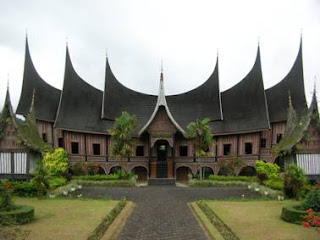
A home gadang, a main house owned by a group of Minangkabau society is bound by a particular tribe. As the main house, the house is a place to establish a large sieve events customs and other important events of the tribe concerned.
Customary activities on Minangkabau society we have described based on their life cycle, namely:
· Rain Shower
· Circumcision
· Marriage
· Batagak Gala (Appointment Datuak)
· Death
Customary function in a large sieve home we could call the function that took place in a temporary home gadang, because the event does not take place every day and takes place at certain times only.
Everyday Function
The house is a container that holds gadang daily activities of its inhabitants. Gadang house is a house inhabited by a large family with all their activities every day. Definition of a large family here is a family consisting of father, mother and daughter, both who have been married or who have not married, whereas boys did not have a place in the house gadang.
This function is actually a more dominant place in a large sieve home. As usual residence for society generally, this is where the interaction takes place between family members. Everyday activities such as eating, sleeping, hanging out with family members and others more dominant place here, in addition to traditional activities as described above.
Along with the passage of time and the increasing activity of the community especially those still using gadang home as residential facilities, has led to the increase of new functions in the home gadang. Architecturally, we know that each activity requires the spaces to accommodate these activities. So also at home gadang, new spaces that appear on the home gadang (transformation space) is a response to the increasing activity as well as the diversity of needs of residents of the large sieve.
we know that each activity requires the spaces to accommodate these activities. So also at home gadang, new spaces that appear on the home gadang (transformation space) is a response to the increasing activity as well as the diversity of needs of residents of the large sieve.
Tower House as a Cultural Artifact
As already described above, the Minangkabau society is a society that embraces matrilineal kinship system, which according to maternal lineage. As a society that embraces matrilineal system, the tribal system was also according to the mother, so if the mother has an interest Piliang then hereditary, the children in these families also have the same tribe with his mother.
Gadang home as a place to live with for the people who live Minangkabau matrilineal system of kinship (according to matrilineal descent) women have a privileged position and place in the home gadang. Any married woman who will get a room, while the youngest female terujung got a room which will then be moved if it has a future husband. The boy has no place on this gadang house, since the former boy-man who started growing up will stay in the mosque-surau family or go wander out of the village.
Houses gadang Minangkabau society in addition to functioning as a residence also serves as a symbol of the existence of a people. Another function of this gadang house is as a place to consult and agree on a place to perform traditional ceremonies, like a rung on the establishment of a house gadang speech, namely:
· Home gadang base HB
· Pole banamo Carbonara nature
· Pintunyo banamo Dalia kiasannyo
· Banduanyo Sambah manyambah
· Bajanjang naiak batanggo down
· Dindiangnyo panutik shame
· Biliaknyo square bunian
The purpose of the speech above is the number of poles contained in a large sieve home is one of the factors that determine the size of the building to be erected, the location of the door determines the alignment system adopted, the pendulum (high-low game gadang floor of a house) which is the boundary between outside and inside the home that can not be passed without any particular order, a walled house mengkiaskan cultural values and civilization while the room is a place to store valuable items.
Broadly speaking, living in a house we can gadang categorizing into
Four main zoning. Penzoningan is based on the hierarchy of spaces contained in gadang house itself, namely:
1.Publik, namely the living room or common space which is a room off without any barrier.
Private 2.Semi, the transitional space contained bandua front bedroom and anjuang (special room) located at the ends of the house gadang which can be found in some types of home gadang.
3.Privat, the bedrooms are there in the house which was formerly based on the large sieve to the number of girls who are owned by sipemilik home.
4.Servis, the kitchen is at once a traditional kitchen are still using wood as fuel.
Some characteristics of the architecture of the house is a large sieve:
1.Tingkat / or the degree of cultural specificity.
Gadang house is a building typical of the region of West Sumatra, as written in the book Minangkabau Tower House of Traditional Architecture, the architecture of the building houses a relic gadang not written to us, which is a hallmark of the past greatness of Minangkabau culture. No matter how the change occurred, but sieve house building architecture which we witness now is the effect of building styles of the past.
model, plan, morphology and building specifications, the relationship between elements and the complexity of the building based on where a building is located.
Broadly speaking gadang home model is divided into two major groups are divided according to two kelarasan or customary law in Minangkabau society.
Both kelarasan system are:
• System kelarasan Koto Piliang
The hallmark of the model homes that use the system kelarasan gadang Piliang Koto is a anjuang found on the left and the building. The pavilion is a place of honor in a large sieve home is elevated a few feet from the surface of the floor of the building.
• System Bodi kelarasan Caniago.
While at home who use the system kelarasan gadang Bodi anjuang Caniago not know the term. So the floor of the house bangian gadang from tip to base have the same height floor.
Building elements in the house gadang it can also be divided into two main parts, namely:
a.Halaman Gadang a home page is an open house is important for an gadang house, usually a home page on the large sieve is a place to hold events on a kinship.
The elements contained in a large sieve home page is:
Rangkiang Rangkiang is a building that contained yard of a house gadang the square and roofed bergonjong fibers that serve as rice storage barn erected in front of the house gadang.
According A.A. Navis (1984) there are several types gadang rangkiang on a house, such as:
a.Sitinjau lauik
This is the kind Rangkiang rangkiang rice storage place that will be sold to buy household needs that can not be made or done alone.
b.Sibayau-bayau
Rangkiang of this type serves as a repository of rice that will be used for everyday purposes.
c.Sitangguang coconut
Is a type rangkiang used as a rice storage place that will be used as a backup during a famine comes.
d.Rangkiang kaciak
Rangkiang used as a rice storage place that will be used as seed and planting paddy processing fee during the next planting.
Tabuah ban Is a rectangular building, thatched roofed and bergonjong to place a drum made of wood length. Usually used as a tool to provide at the time of danger signs or notices at the time there is an event.
Lasuang and pestle Is a home gadang fittings commonly used as a tool to pound rice.
Kitchen Service area on the home gadang which usually also part of the house, but in most home kitchens gadang gadang usually separate from the house.
b.Elemen building Building elements contained in a large sieve home is:
• Password
Foundation is contained in a large sieve house from natural stones.
• Ladder
Stairs on a house made of materials gadang wood materials and is usually preceded by a natural flat stone, usually the number of steps is odd number, like 5, 7 and 9.
• The pole
There are various names and types of columns on a house, giving the name on each pole at a house gadang is adapted to function at home and it's large sieve.
• Beams
Is the binder between the pole with a pole on a house that ran large sieve at the top or the bottom of the pole.
• Space
Space or space on a large sieve house is a room that is formed by rows of columns that ran in the house the large sieve.
• room
Booth is a private area for the occupants of a house large sieve, sieve chamber at the base of the house inhabited by parents and children while unmarried girls booth located at the end of the house inhabited by a large sieve bridal couple.
• Walls
The walls of the house gadang divided into three parts, the front wall, the wall Sasak, as well as the side walls. In general, the wall at home gadang is made of woven bamboo is bound by the boards as tulangannya.
• Roof
The roof of a house gadang usually consists of fibers, although in the present use of these fibers has been replaced by widespread use of zinc material.
• gonjong
Gonjong are characteristic of traditional residential Minangkabau society, so that residential Minangkabau society is also known as the home bagonjong.
+-The use of certain materials, colors, textures and have a relationship with the landscape.
The principle of housing construction is to use the large sieve techniques and local materials as well as a response to the environmental setting where the building is located. The main materials used in building houses a large sieve there is lots of wood materials around the site where the building will be erected. And bring natural colors in its use.
Minangkabau society is a society that lived communally or collectively, as well as having a strong kinship ties. This is reflected by the presence of open space or open space contained in each group residential facilities or group them (houses gadang) which is a container for a place to socialize for the people.
+-Clarity, appearance and ease of understand of the model used
A home gadang is a product architecture that emerged and developed in Minangkabau society. No other buildings are located in Indonesia in particular building typology that has truly synonymous with large sieve-like home custom home located on West Sumatra. Just as in the use of roof elements, a transformation of form gonjong designed terraced and has a certain ratio in the angle and height in which it will not be found in other areas of architectural products that are in Indonesia.
So, if we see a building that has the characteristics as described in the previous section then we will say directly that the building is one of the buildings from Minangkabau (West Sumatra).
+-Complexity based on the time change, the conditions that allowed open-ended process of adduct (transformation) based on user activity that is plural and the addition of this type and amount.
Based on the philosophy of life Minangkabau society, namely 'natural takambang be a teacher' contains a spirit that all changes from the surrounding environment should be a lesson in Minangkabau society itself.
In simple terms we can say that the Minangkabau society is a society that is not closed to change, as do the houses where they lived.
Increased family members and the increasing need for space in the residence, not close to the occurrence of transformation in their residential setting, whether it's the transformation that occurs in space in a home setting gadang and outer space.
In a small scale we can see, the establishment of new buildings that are around the house gadang, is one of the answers are no longer home gadang inability to accommodate the needs of the occupants. And the shifting of kinship systems which are usually referred to as family nucleus becomes ekstended family, are the kinds of transformation that is the answer to the philosophy of 'natural takambang be a teacher' is.
CONCLUSION:
Minangkabau society is a civilized society, the absence of one kegiatanpun Minangkabau society in everyday life apart from the traditions that they hold dear for this.
Matrilineal kinship systems which profess meraka during impact and also provide a huge influence in the life of this Minangkabau society. Gadang house, which is one of the Minangkabau cultural artifacts are also much influenced by the matrilineal system.
Gadang home is one form of culture results Minangkabau society truly born of the consequences of matrilineal system adopted by the Minangkabau society. One can clearly see the rooms in the house gadang settings, such as system usage and the lack of room to place their boys in the house gadang.
The increased activity and increasingly diverse needs of Minangkabau society, not close to the transformation of the house gadang. As a dynamic community and embrace the philosophy of life 'nature takambang be a teacher' has hinted that the Minangkabau society is a society that is always open to change and will evolve according to the demands of life and increased community activity.
source : www.yahoo.com
Posted by wahyu at 5:24 AM 0 comments
Labels: indonesia
Tujuh Kota Impian Baru
Wednesday, October 5, 2011Sejak Indonesia mengalami era pembangunan, Jakarta seolah menjadi pusat segalanya. Baik itu kegiatan ekonomi, pengambilan keputusan-keputusan politis, maupun pusat kehidupan. Selama berpuluh-puluh tahun, berbagai media di Indonesia juga menyoroti permasalahan Jakarta (kemacetan, banjir, kepadatan penduduk) seolah semuanya adalah persoalan nasional.
Sementara itu, ada berbagai pusat ekonomi baru dan kota-kota yang tumbuh, menyejahterakan penduduknya, tapi tidak tersorot oleh media nasional. Cerita-cerita tentang kehidupan mereka yang tinggal di luar Jakarta luput dari perhatian. Padahal, menurut kami, cerita-cerita ini penting untuk menunjukkan bahwa peluang meraih pendapatan ada di berbagai kota di Indonesia (meski pemerataan kesempatan masih jadi isu besar di negeri ini).
Melalui artikel "Mencari Pesaing Berarti buat Jakarta", kami mencari cerita-cerita tentang kota-kota lain yang menggiurkan buat pencari kerja, tapi belum mendapat porsi besar pemberitaan. Dan kami menerima banyak masukan serta cerita. Berikut daftar kota yang masuk dalam usulan menjadi pesaing Jakarta.
1. Solo
Banyak surat elektronik yang kami terima berasal dari warga Solo yang bangga dengan kota mereka. Seperti dari Rizky Ayu yang menyebut bahwa keberadaan pasar tradisional yang nyaman dan bersih, angkutan umum dengan standar profesional terukur, serta terjaganya kampung-kampung budaya dan festival tahunan sebagai faktor kebanggaan Solo.
Potensi wisata mendukung terciptanya lapangan pekerjaan. "Mau kerja kantoran? Bisa. Banyak perusahaan yang membutuhkan tenaga Anda di sini. Mau wiraswasta? Apalagi! Ada banyak peluang bisnis di sini bila Anda jeli. Anda tidak perlu takut digusur Satpol PP yang bersenjatakan pentungan bila berdagang kali lima di sini. Ada sejumlah shelter di tempat-tempat strategis yang siap untuk Anda pakai berjualan," kata Rizky dalam emailnya kepada kami.
Murahnya harga kebutuhan hidup pokok serta jalanan yang tidak macet juga menjadi faktor plus lainnya. Kualitas sekolah dan universitasnya pun cukup tinggi.
2. Surabaya
Adji Setiawan dulunya tinggal di Jakarta. Lalu pada 2006 ia memutuskan untuk hijrah ke Surabaya dan memulai usaha desain interior dari nol. Yang membuatnya terkaget-kaget adalah, "(Memulai) usaha di Surabaya jauh lebih mudah dengan kecepatan jauh lebih cepat daripada memulai usaha di Jakarta." Kini ia tak mengaku tak mau lagi tinggal di Jakarta. "Sekarang tergantung pihak pemerintah dan media, untuk tidak selalu menyorot Jakarta dengan 'kemegahan' palsunya," tambah Adji.
3. Palembang
Buat Sonny Chandra Thawab, Palembang terus membangun tapi tidak terobsesi dengan modernitas, bersahaja dan religius. Buat seseorang yang baru menetap di Palembang sejak 9 tahun lalu, Palembang adalah kota yang memberi kesempatan buat pendatang. Kebanggaan terhadap makanan tradisional dan pakaian tradisional juga tetap terjaga.
4. Semarang
Bagi anto_bgd_jayuzz, penataan Kota Semarang memberikan ruang publik yang nyaman bagi warga untuk nongkrong. Kawasan bersejarah pun dipugar kembali untuk menjadi salah satu pilihan wisata. Angkutan kota Trans Semarang yang tertib pun memberikan alternatif nyaman transportasi publik.
5. Yogyakarta
Menurut Andre Veriangga, Staf Kependudukan Pemerintah Daerah Sleman, DI Yogyakarta, Yogya adalah kota ideal pilihannya. "Banyak yang bisa kita dapatkan di kota ini, mulai dari fasilitas pendidikan murah dan beragam, transportasi yang memadai ke seluruh penjuru wilayah, birokrasi pemerintahan tidak berbelit-belit, makanan beragam dan murah meriah, kebudayaan masih asli, ramah tamah penduduk asli yg mampu berdampingan dengan etnis lain maupun pendatang, dan kemudahan pihak-pihak dalam negeri atau asing untuk berinvestasi," tulisnya dalam email.
Selain itu, tidak ada macet juga menjadi salah satu faktor kenyamanan hidup di Yogya. "Tidak akan terlihat wajah-wajah tegang di pagi hari terburu-buru masuk kantor, semrawut kendaraan yg menyebabkan kemacetan panjang hingga berjam-jam, keteraturan pola kehidupan saat pagi-siang-sore-dan malam, kemudahan menjangkau wilayah-wilayah tertentu sesuai keinginan, bahkan akses jalan di kota kami sangat mudah." Terdengar sangat menggiurkan bukan?
6. Balikpapan
Kekayaan alam Kalimantan juga memunculkan pusat-pusat ekonomi. Juliet menyebut Balikpapan sebagai pintu gerbang utama Kalimantan Timur. "Setiap tahun, orang-orang dari berbagai daerah (Jawa, Sulawesi, Sumatra, dsb) berbondong-bondong mencari nafkah dan mencoba peruntungan hidupnya di kota Balikpapan. Apalagi dengan banyaknya perusahaan investor asing yg berdiri dan berkantor di Balikpapan," kata Juliet.
Deky Rohie juga menyebut Balikpapan sebagai kota idaman. "Banyak perusahaan-perusahaan asing yang memberikan gaji besar, minyak berlimpah, sumber mineral dan batubaranya banyak," dia memberi alasan.
Buat Amiruddin M, Balikpapan juga menjadi salah satu kota yang ia rekomendasikan, meski ia menyebut kota-kota lain di Kalimantan Timur (Kutai Kartanegara, Bontang, Nunukan dan tempat tinggalnya, Samarinda). "Berbicara tentang Jakarta bagi saya bukanlah tempat yang menarik," kata dia. Ia pernah berkuliah di Jakarta, tapi untuk tinggal, "ratusan kali berpikir (ulang)."
"Kalau anda mau mencari uang datanglah kemari. Kota kami menawarkan kepada Anda ribuan lowongan kerja hampir setiap bulan dengan spesifikasi lapangan kerja yang bervariasi, mulai dari sektor pertambangan, perkebunan dan industri. Semua menjanjikan rupiah yang tidak sedikit," ia mengiming-imingi.
7. Batam
Penerapan zona ekonomi membuka peluang pekerjaan di kota ini. Cerita dari Nurul Fajar Sulistyowati, Putri Ajah dan Wenchy Gibs Zulu memberikan gambaran yang kurang lebih sama. Awalnya mereka ragu dengan peluang yang diberikan Batam, sampai tidak tahu Batam ada di mana. Tapi kemudian pemasukan yang mereka dapat berhasil menaikkan kelas sosial.
Bahkan, menurut Nurul Fajar, "Di sini aku bisa mendapatkan penghasilan dan menguliahkan adikku, membeli rumah, serta (membeli) kendaraan pribadi." Dan ini dengan level pendidikannya yang D1, sementara suami Nurul berpendidikan D3.
Menurut Nurul, ia berusaha mengajak dan membantu teman-temannya untuk mendapat pekerjaan di Batam, tapi mereka enggan karena citra Batam di masa lalu. Padahal, "Ada juga Bintan, Pekanbaru, Natuna, Tanjung Balai Karimun dan pulau lain di sekitarnya yang menyajikan berlimpah kesempatan untuk para pencari kerja." Anda tertarik?
Kota-kota yang disebut di atas bisa berkembang karena kekayaan alam atau keputusan-keputusan politik dari para pemimpin daerah. Meski begitu, Widi Anto yang tinggal di Sukoharjo lebih memilih mengandalkan kemajuan teknologi, terutama internet, untuk berusaha. Ia tak terpaku pada pembangunan kota yang dilakukan oleh pemerintah.
"Walaupun kurang didukung infrastruktur yang baik tapi paling tidak di zaman digital seperti ini, masyarakat bisa lebih mandiri untuk membangun ekonomi daerahnya. Misalnya dengan memaksimalkan jalur online untuk mengangkat produk-produk lokal ke pasaran yang lebih luas, bahkan kalau bisa pangsa pasar luar negeri." Dengan menawarkan batik, furnitur atau kerajinan tangan via internet, menurut Widi, kesuksesan tak perlu bergantung pada lokasi tinggal Anda.
Nah sekarang, kami ingin tahu cerita-cerita dari mereka yang berdiam di Jakarta. Kira-kira, apa yang bisa membuat Anda meninggalkan Jakarta dan mencari peruntungan di kota lain?
source : yahoo.com
Posted by wahyu at 2:25 AM 0 comments
Labels: indonesia
Festival Gunung Krakatau
Monday, February 28, 2011Posted by wahyu at 2:57 PM 0 comments
Labels: indonesia
Festival Bunga Tomohon
Wednesday, February 16, 2011Posted by wahyu at 3:00 PM 0 comments
Labels: indonesia
Danau Sentani "Surga" Tersembunyi
Sunday, February 13, 2011Danau Sentani di Papua terletak antara 20.33 hingga 2041 LS dan 1400.23 sampai 1400 38 BT. Berada 70 - 90 m diatas permukaan laut. Terletak juga diantara pegunungan Cyclops. Merupakan danau Vulkanik. Sumber airnya berasal dari 14 sungai besar dan kecil dengan satu muara sungai, Jaifuri Puay. Diwilayah barat, Doyo lama dan Boroway, kedalaman danau sangat curam. Sedangkan sebelah timur dan tengah, landai dan dangkal, Puay dan Simporo. Disini juga terdapat hutan rawa di daerah Simporo dan Yoka. Dalam beberapa catatan di-sebutkan, dasar perairannya berisikan substrat lumpur berpasir (humus).
Pada per-airan yang dangkal, ditumbuhi tanaman pandan dan sagu. Luasnya sekitar 9.360 Ha dengan kedalaman rata rata 24,3 meter. Disekitaran danau ini terdapat 24 kampung. Tersebar dipesisir dan pulau-pulau kecil yang ada ditengah danau.
Bertempat di Plaza Indonesia Extension, Jakarta, Sabtu (30/1), semua keindahan Danau Sentani diabadikan lewat foto-foto yang dipamerkan dalam "Festival Danau Sentani" dan Peluncuran Buku "Doors to the Unknown The Story of Sentani in the Jayapura Regency of Papua"
Acara yang diprakarsai oleh Bupati Jayapura, Habel Melkias Suwae ini merupakan upaya sang bupati untuk mempromosikan kekayaan wisata di Jayapura, khususnya di Sentani yang memiliki "harta karun" berupa keindahan alam, sejarah serta adat dan budaya khas Papua,
Selain untuk memperkenalkan berbagai tujuan wisata di Kabupaten Jayapura, acara ini lebih jauh digagas Habel untuk menampilkan secara utuh kondisi di Jayapura yang sebenarnya, dan menepis bayangan negatif sebagian masyarakat yang belum pernah berkunjung ke kabupaten di tanah Papua itu.
Pameran foto "Festival Danau Sentani", secara khusus diselenggarakan dalam rangka mempromosikan Festival Danau Sentani (FDS), yang digelar setiap tahun pada bulan Juni di Pantai Kalkote, Kampung Harapan, Distrik Sentani Timur, Kabupaten Jayapura, Papua. Dalam salah satu pernyataan resminya, bupati Habel mengatakan bahwa tujuan utama penyelenggaraan FDS, adalah untuk melestarikan nilai-nilai budaya masyarakat setempat, merekatkan rasa persatuan dan kesatuan di antara kampung adat, serta menjadikannya sebagai daya tarik pariwisata yang akhirnya akan berdampak pada peningkatan kesejahteraan masyarakat setempat.
FDS pertama kali digelar pada tahun 2008 Di sela-sela acara pameran foto FDS, juga akan diadakan peluncuran buku meja kopi (coffee-table book) karya TSA Komunika -Anto Dwiastoro dan Toni Sri-, Doors to the Unknown The Story of Sentani in the Jayapura Regency of Papua, yang bermuatan 30 persen teks dan 70 persen foto serta ilustrasi, yang memaparkan informasi menyangkut Sentani, FDS, keindahan alam dan wisata sejarah di daerah Jayapura.
Buku "Doors to the Unknown A Story of Sentani in the Jayapura Regency of Papua", diharapkan mampu memberikan gambaran utuh tentang dahsyatnya potensi wisata Jayapura. Menuturkan pengalaman sang penulis dan fotografer ketika pertama kali menjejakkan kala di Sentani, buku ini laksana membuka pintu-pintu menuju hal-hal yang tidak diketahui sebelumnya tentang keindahan di sebuah kabupaten, nun jauh di sana.
Source : yahoo.com
Posted by wahyu at 9:32 PM 0 comments
Labels: indonesia
Parangtritis Beach, Jogjakarta
Wednesday, March 24, 2010Source : www.wikipedia.org
Posted by wahyu at 5:14 AM 0 comments
Labels: indonesia
Taman Sari Water Palace
Taman Sari, Yogyakarta was founded in 1758 that the idea originally from Prince Mangkubumi (who later styled Hamengkubuwono I) and Raden Ronggo Prawirosentiko (Regent Madison) as an architect, while Demat Tegis (a Portuguese native who received his from the kingdom) as experts in structure .
There are several elements that influence the architecture of this complex, Taman Sari, including the influence of Hindu and Buddhist, Javanese and Islamic, Chinese, Portuguese and European styles, can be seen in some parts of this building.
Taman Sari - Yogyakarta has two main gates, namely the Great Gapuro (at the end of the West) and Gapuro Stage (at the end of the East, which is currently (in 2007) is used as the main entrance to Taman Sari location of this complex).
Form the gate or the 'very beautiful Gapuro'nya which is the original style of Java, the details of this Gapuro an original motive of stilasi Java like tendrils of plants, birds, bird's tail and eagle wings.
source : www.wikipedia.org
Posted by wahyu at 5:08 AM 0 comments
Labels: indonesia
Malioboro, Jogjakarta
There is some historic objects in this street include Tugu Yogyakarta, Tugu Station, Court House, Market Beringharjo, Fortress and Monument Vredeburg Oemoem attack March 1.
The road is very popular with street vendors hawking their handicrafts and distinctive jogja stalls at night lesehan is selling typical foods jogja gudeg as well known as a gathering place of artists, artists often express their abilities such as playing music, painting, hapening art, mime and others along this path.
Source : www.wikipedia.org
Posted by wahyu at 5:00 AM 0 comments
Labels: indonesia
Jogjakarta Tourism Places of Interest
In the south of Yogyakarta city, precisely in the area Wonokromo, there Klathak Sate.
Posted by wahyu at 4:58 AM 0 comments
Labels: indonesia
Jogjakarta Culture
Posted by wahyu at 4:41 AM 0 comments
Labels: indonesia
Yogyakarta Special Region
IN Province. Yogyakarta has a public service supervision agency called the Regional Ombudsman of Yogyakarta which was established by the Decree of Governor of DIY. Sri Sultan HB X in the year 2004.
Yogyakarta Special Region is a province based on the region Yogyakarta Sultanate and the Duchy Pakualaman. In addition to by the former region and the Sultanate of Surakarta Kasunanan Mangkunegaran previously an enclave in Yogyakarta.
Government of Yogyakarta Special Region can be traced from their origins in 1945, and even before that. A few weeks after the proclamation of August 17, 1945, at the insistence of the people and after seeing the conditions there, Hamengkubuwono IX issued a royal decree, known as 5 September 1945 Mandate Wikisource-logo.svg. Contents of these decrees is the integration of the monarchy in Yogyakarta Indonesia. Decree with similar content was also issued by the Paku Alam VIII on the same day. Decree of integration with the Republic of Indonesia such actually issued by the monarchy in the archipelago, although not a monarchy is waiting for upholding the Netherlands Indies government after the defeat of Japan.
At that time Yogyakarta Sultanate rule include:
1. Regency Yogyakarta with KRT Hardjodiningrat regent,
2. Sleman regency with Pringgodiningrat KRT regent,
3. Bantul District with regent KRT Joyodiningrat,
4. District Gunungkidul with KRT Suryodiningrat regent,
5. District Kulonprogo with Secodiningrat KRT regent.
While Nail Alamans Praja power include:
1. Regency City Nails Alamans with regent KRT Brotodiningrat,
2. District Adikarto with KRT Suryaningprang regent.
By leveraging the momentum of forming the National Working Committee Region of Yogyakarta in Indonesia October 29, 1945 by Moch chairman and vice chairman Saleh S. Good Joyodiningrat Hadikusumo and Ki, then a day later, with the Working semufakat KNI Region of Yogyakarta, Hamengkubuwono IX and Paku Alam VIII issued a royal decree together (known as the October 30, 1945 Mandate Wikisource-logo.svg) that it handed over power to the Working Legeslatif KNI Region of Yogyakarta. From that time also the ruler of the kingdom in the southern part of Java decreed together and start a union of two kingdoms.
Since then not only the royal decree signed by the ruler of the monarchy but also by the chairman of the Regional Working Committee KNI Yogyakarta as a symbol of popular approval. The development of the unity of the monarchy through ups and downs. On May 18, 1946, the official name of Yogyakarta Special Region began to be used in governmental affairs emphasized the unity of the two kingdoms to be a special area of the State of Indonesia. Use of these names are in Notice No. 18 of the Council-House of Representatives in Yogyakarta Special Region (see Notice of Yogyakarta No. 18 Year 1946 Wikisource-logo.svg). Government remains united monarchy lasted until the issuance of Law No. 3 Year 1950 on the establishment of the Special Region of Yogyakarta, the area confirmed the Sultanate of Yogyakarta and Paku Alaman is an integral part of the State of Indonesia.
"(1) An area that includes the Sultanate of Yogyakarta and Paku Alaman area set into the Special Region of Yogyakarta. (2) Special Region of Yogyakarta is level with the province." (Article 1 of Law No. 3 Year 1950).
source : www.wikipedia.org
Posted by wahyu at 4:35 AM 0 comments
Labels: indonesia