Showing posts with label Cambodia. Show all posts

Cambodia : 7 Enchantment of Siem Reap

Thursday, January 5, 2012

Justify FullSiem Reap, the city of the former headquarters of the army-ruled country bloodthirsty ruler of the Khmer Rouge, now developed wonderfully to become an international tourist destination. Even Siem Reap gain status as a World Heritage Site of UNESCO and one of the Seven New Wonders of the World. Though only 20 years ago this area off limits to tourists, local residents terrorized and dominated by the fear of one of the most brutal regimes in the world.


Today, with ancient ruins in the Angkor Wat, Siem Reap, a city that lives and in 2007 received approximately one million visitors through its international airport. Although Angkor Wat is the center of attraction, but that does not mean the city of Siem Reap did not receive attention, with a restaurant facility, the best museums and galleries in the region.


Angkor Wat is Amazing

Angkor Wat temple is the largest, most well maintained, has the most intricate designs and most admirable in Indochina, a crown jewel in a vast Angkor empire. The temple is a source of national pride and international recognition, veiled reliefs of the Hindu epic Ramayana. Like most Hindu temples in Asia, Angkor Wat looks more beautiful at sunrise or before sunset, when the sky filled with colors that accentuate the fifth tower.


Nine Figures

To know Asia first you must understand the trust on the continent, and this is seen clearly in the Angkor Thom, a temple that fixated with the number nine. Pronunciation of "nine" is similar to the word "development", and almost everything on the temple can be compared to this figure - 54 towers carved, 216 faces in the tower, 54 gods on the left of the entrance, and 54 demon on his right - all these figures can be added to the number 9.


Other temples

Another Angkor temple is also famous Ta Prohm, surrounded by the roots of trees hundreds of years old. The roots of the tree makes Ta Prohm object image so interesting that successfully achieve tourists. Bayon is also known as "Temple Faces", and when you are there, it's easy to understand why the name was girded. Once you climb the stone steps to the shrine inside the temple, when looking up will appear hundreds of stone carvings of faces looking at you. There is also Banteay Srei, a temple filled with stunning carved stone that meets every inch there. Even with current technology, it is almost impossible to make the patterns as precisely and as complicated as it is on a stone statue.


River Revitalization

About 50 miles northeast of Siem Reap, there is the Thousand Linga River flows into the river in Siem Reap which is essentially filled with carvings Linga - phallic symbols are very common in Cambodia. Estimates, the engravings were made between 1100-1300 to symbolize fertility. Now the river is a perfect place to enjoy the tropical beauty of Siem Reap.
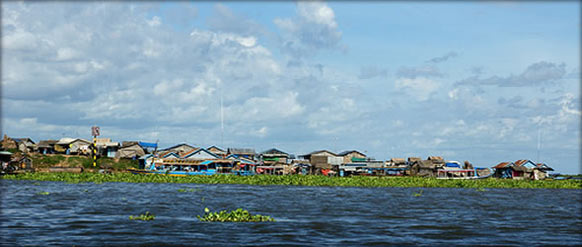


Tonle Sap

Siem Reap not only have one world-famous archaeological sites, but also has one of the largest and most colorful lakes in Southeast Asia. UNESCO has set the Tonle Sap as a biosphere nature reserves, wildlife sanctuaries into the water and habitat for several rare birds to be the only river in the world that the water flow changed two times a year.


Contemporary Art

Art in Siem Reap is in progress, you can find anything from cheap souvenirs to expensive artwork. Some places are noteworthy art lovers, among others: the McDermott Gallery, where world-class photography will Angkor and surrounding areas exhibited; The Red Gallery, which has the most diverse collection of contemporary art from Cambodia; and The Asia Craft Center, where various kinds of traditional crafts are Cambodia and Southeast Asia.
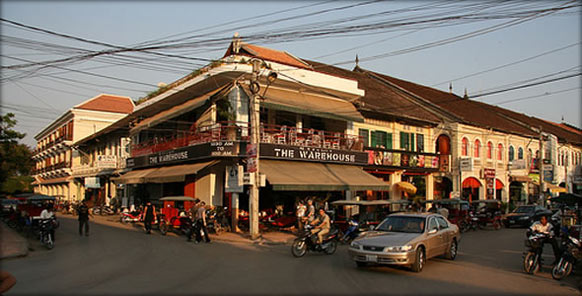


Colonial Architecture

Siem Reap has colonial era buildings, relics of the French who are now converted properly. Located at the intersection and the roundabout quiet, the buildings became hotels, restaurants and the best gallery in Siem Reap, such as Raffles Grand Hotel D'Angkor, the most luxurious hotel in the town that was founded in 1932. The hotel was once visited by a variety of VIP guests, including King Norodom Sihanouk, Charlie Chaplin, the Sultan of Johor and even Jacqueline Kennedy.

source : www.yahoo.com

Peering Dark History of Cambodia

Thursday, December 29, 2011

In the mid-1970s, Cambodia's Khmer Rouge regime controlled by the leadership of Pol Pot, who has ideals transform Cambodia into an agrarian state with ultra-Maoist adopts. He was moving people from city to village to work in the fields and kill anyone who opposes. Many innocent people, including women, children, and parents who are victims of atrocities the Khmer Rouge regime.

Ek Cheoung


Some tourists walked through mass grave Cheoung Ek on the outskirts of Phnom Penh, Cambodia. Photo Credit: AP / Heng Sinith


Located about 14 km from Phnom Penh, the capital of Cambodia, Cheoung Ek is one of the Khmer Rouge regime killed and buried the people who are considered against the power of the regime. The prisoners who were imprisoned in Tuol Sleng (read article Part 1), will be brought to Cheoung Ek to be killed.

I went to Oak Cheoung using tuk-tuk for an hour, with a fee of $ 7.The road to the outside of the city is very dusty, so I had covering her face with a scarf. At first glance, this place looks like a garden with shady trees. Many butterflies are also flying. The souvenir merchants offering their wares.


Admission to the Cheoung Ek is $ 2 (although the official currency of Cambodia is the Riel, they also accept payments in U.S. dollars).

In Cheoung Ek, the most prominent building is a high tower, in which there are approximately eight thousand piles of human skulls regime of Pol Pot's atrocities. Piles of used clothing of the victims are also displayed in the tower. The tourists, including me, was busy taking pictures. The scenery was incredible and tragic.No one is laughing and joking when taking pictures.

Completed around the tower, I decided to surround the complex Cheoung Ek. In a corner, I saw a variety of killer tool that was used to kill the prisoners. Bayonet, iron chains, and various other killer equipment.

In the other corner I found a large hole to the instructions in local languages ​​and English that roughly reads "Here was found a pile of victims without heads". While in other places there are signs "Here is found the victim in a state of naked women". There are many other signs as chilling.

Fortunately, in contrast to Tuol Sleng, Cheoung Oak is an open field so it does not seem so terrible. The tower which rises with a pile of skulls still dominate this place.

Although the stomach is wrapped around, and there are several food stalls outside the complex, I do not have appetite to eat. I decided to return to the city center and spend time in the city.

Alternative attractions in Phnom Penh

Cambodia is an attractive country, with a remarkable history.Tragic, cruel, yet memorable. However, if you're not a history buff, especially those related to war and torture, there are many sights to see in Phnom Penh.


Palace of King Norodom with Silver Pagoda in it is one you must visit. This place is very beautiful with neat gardens. Another alternative is the National Museum, which is also the place where historic objects, but from the more remote than with the history of the Khmer Rouge.

The Royal Palace in Cambodia, one of the interesting attractions to visit. Photo Credit: AP / Heng Sinith

Wat Phnom, a pagoda in the middle of the city are also worth visiting. You can go up and take pictures with the existing reliefs and statues. In this place a lot of monkeys, so be careful with your belongings.

If you love to shop, you have to go to the Russian Market or Russian Market. This place sells a wide range of souvenirs, ranging from silks, jerseys, clothing, and knick-knacks. Prices in the Russian market is relatively inexpensive and most importantly, easily negotiable!

Source : www.yahoo.com

Peering Dark History of Cambodia

Tuesday, December 27, 2011

Tourism in Cambodia is not only limited to Angkor Wat, a magnificent Buddhist temple, but also a tourist attraction with a dark history that lies to the east of the country.

Cruelty group leader Pol Pot's Khmer Rouge in the 1970s left a deep wound for Cambodians today. But the legacy became a tourist attraction, especially for those who like history.

A tourist goes to see the photos of detainees who had entered the S-21 prison in Phnom Penh, Cambodia. Photo Credit: AP / Heng Sinith

I started my journey with a visit to this museum, which is approximately a one hour drive from Phnom Penh International Airport. I arrived at their destination about three o'clock, so it still has about two hours to explore the place.

At first I thought Tuol Seng is just an ordinary museum, which is also found in many other countries, but apparently not. This place presents something very different.

Tuol Sleng was once a high school in 1975 converted into a prison called Security-21 or S-21. Reportedly there were about 17 to 20 thousands of innocent Cambodians and some foreigners who had been imprisoned here. And of all people arrested, only seven people who survived until the Khmer Rouge regime was overthrown.

Entering the complex Tuol Sleng, still not seeing anything different until I approached one of the buildings. On the walls seen a sign that prohibits visitors laughing and joking. I went inside. It's hard to express what I feel inside the building. The school has been converted into a torture camp.

Classrooms filled by various means of torture, iron chains, while from the window I could see the high fence of iron wire. Other spaces that have been transformed into cells measuring 1x1 meters. Blood spots are still visible everywhere.

For me, and I'm sure for other visitors, a sign of forbidden laughter is of no use. See what is inside, it's impossible for us to laugh and joke. The place was like happiness absorb anyone who visited. If I may borrow JK Rowling's imagination, was at Tuol Sleng like to be near the dementors!

In another room we saw a variety of facial images. The officers photographed every S-21 prisoners who go to prison. All with a blank expression. Look as if they imply that they know life will not be long anymore. And before death must have been tortured beyond the limits of humanity.

I rent a tour guide who explains the country's dark history. He tells his own experience, how his father and older brother was captured by the Khmer Rouge and never returned. He also tells about the crying babies being thrown away by the guards S-21 to the barbed wire.

One of the most prominent in this place is a Map of the Skull, which is a map of Cambodia made of 300 human skulls. Elsewhere castoffs prisoners stacked into one. Photographs and paintings depicting the torture of innocent people on the wall. Somehow, even after decades of metallic smell of blood still smelled.

The sun began to sink, any visitor to stay a bit. I completed the tour as soon as possible to get down to the page. At the very least, open-air atmosphere less dire than in the living-room that smelled blood. Outside, there are still many torture device used by the guards S-21. One is a large barrel-lined barrel.

In the past, students use the vat of water to wash the face. However, when the place was converted into a prison, officials built on top of the pole-barrel keg is. Prisoners will be hung upside down, with head immersed in water.

My tour ended that day. My journey peek dark history of Cambodia will continue in the 'killing fields' Choeung Ek, in the next article.

source : www.yahoo.com

Candi Magis Siem Reap

Friday, December 16, 2011


Temple complex that surrounds the small town of Siem Reap is now no longer hidden. Now, all people have friends who've never climbed the towers of Angkor Wat. De facto, the main temple of Angkor Wat into Cambodia. Towers visible in the middle of the Cambodian flag and the label of national beer, Angkor Beer.

But there are hundreds of temples in Siem Reap, either already damaged or that are still preserved. Unless you are visiting for a few weeks, you may not be able to see all the temples. Here are three temples play I recommend to you visit. I did not include Angkor Wat for two reasons: 1) It is not my favorite, and 2) That a large temple complex with a complex history and significant, so you can not miss.


Bayon

Bayon Temple is known as the Front (Temple of Faces). When you visit, will be very easy to find out the reason behind the name - when climbing steep stone steps toward the holy temple, hundreds of faces will look in your direction. Although they appeared smiling, I feel there is little air is dangerous, as if the makers are waiting for the stone statues to walk back from the woods. Although many temples were destroyed, still easy to imagine the incredible scenery when the complex was first built - the earth is really a house worthy of the gods.

Ta Prohm

If you ever watched Tomb Raider, some movie scenes that take place in the temple of Ta Prohm, do not need special effects to give the impression of spooky and surreal. Temple complex is located in a state of near-collapse. For centuries rooted tree on the temple walls. The preservation of the temple leave those trees because, so it is rooted, trees strengthen the construction of the temple. If omitted, then the temple was left would collapse.

Ta Prohm has a magical effect similar to the Bayon, it's like building a temple or anyone who lived there was out briefly for a walk, and for exploring the spaces is a violation of the hidden temple. Find a quiet corner, relax and feel the mystical Ta Prohm.


Banteay Srei

During the first ten minutes at Banteay Srei, you will continue to stare amazed at the intricate carving every inch a rock, wondering what exactly is it made of wood. Even with today's technology, almost unbelievable that the intricate patterns and details on the statue can be made in stone. This temple, unlike the others, made of red sandstone carved making it easier and give reddish gold hue on the complex.

Most of the entrance and tower of the temple are still preserved and intact condition (be careful of your head because the door is quite short!), But some of the statues on the side of the ladder is actually a replica. Original statue is stolen or has been stored in museums. If there is an art contest, Banteay Srei would win easily because of originality and attention to detail.

source : www.yahoo.com